The Polyphonic Structure of “Grand Dong Song” is Similar to the Teaching System of European Polyphonic Music
DOI:
https://doi.org/10.70393/6a6574.333330ARK:
https://n2t.net/ark:/40704/JET.v3n1a01Disciplines:
Curriculum and InstructionSubjects:
Teaching StrategiesReferences:
7Keywords:
Vocal Music Education, Dong Music, Polyphonic Music, Teaching Method Comparison, Music Development DirectionAbstract
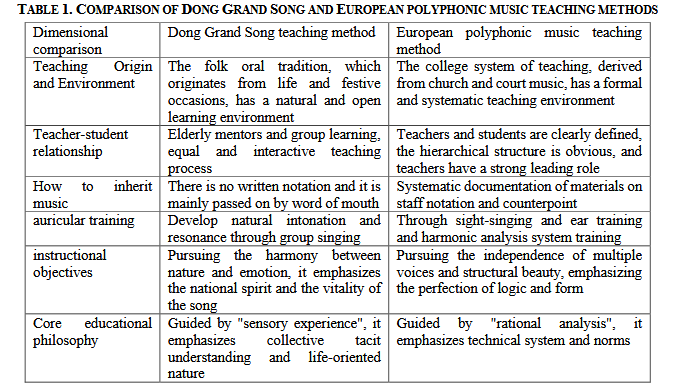
The Grand Song of the Dong people is a unique polyphonic folk chorus form developed by the Dong ethnic group in southwestern China over a long period of life, characterized by "no conductor, no accompaniment, and natural harmony." This singing style is regarded as "the polyphony of the East." In the European polyphonic system, such as the Renaissance period's Palestrina and Bach's fugue period, it represents the pinnacle of Western polyphonic music development, and the Grand Song of the Dong people also possesses similar performance methods. The purpose of this study is to reveal similar performance methods under different cultural environments. By comparing the similarities and differences between the Grand Song of the Dong people and European polyphonic choral singing in terms of vocal part division and high-pitched resonance relationships, this study explores the application value of the Grand Song of the Dong people's singing methods in ethnic vocal music education. The main research methods include musicological theoretical analysis, teaching feedback from Dong ethnic minority students, interviews, and rural surveys in Dong villages, with conclusions compared against the teaching models of polyphonic music in the European music system. This study examines the positive impact of this singing form of the Dong people on vocal music education.
References
[1] Cao, H., & Woramitmaitree, N. (2023). The process of transferring knowledge through Grand Songs among the Dong ethnic group in Southeast Guizhou, China. Education Quarterly Reviews, 6(1), 262–270. https://doi.org/10.31014/aior.1993.06.01.704
[2] Tang, M., & Phaengsoi, K. (2024). Contemporary educational approaches to the literacy and development of the Dong Grand Songs. International Journal of Education & Literacy Studies, 12(3). https://files.eric.ed.gov/fulltext/EJ1434948.pdf
[3] Kim, Y. (2015). A practical approach to the Renaissance counterpoint based on Zarlino’s pedagogical principle. GSTF Journal of Music (JMusic), 2(2). https://doi.org/10.7603/s40958-015-0002-6
[4] Schroetter, A. (2024). Teaching fundamental choral ensemble techniques through secular Renaissance polyphony [Doctoral dissertation, Ball State University]. Cardinal Scholar. https://cardinalscholar.bsu.edu/items/e6a6a6fb-cc0a-42dd-adad-e0e27c9edde4
[5] Fitch, F. (2021). Renaissance polyphony. Music and Letters, 102(4), 813–817. https://doi.org/10.1093/ml/gcab097
[6] Long, M. K. (2023). Sixteenth-century polyphony and the modal paradigm. Open Access Musicology. https://www.openaccessmusicology.com/essays/sixteenth-century-polyphony-and-the-modal-paradigm
[7] UNESCO. (n.d.). Grand Song of the Dong ethnic group. UNESCO Silk Road Programme. https://en.unesco.org/silkroad/silk-road-themes/intangible-cultural-heritage/grand-song-dong-ethnic-group
Downloads
Published
How to Cite
Issue
Section
ARK
License
Copyright (c) 2026 The author retains copyright and grants the journal the right of first publication.

This work is licensed under a Creative Commons Attribution 4.0 International License.